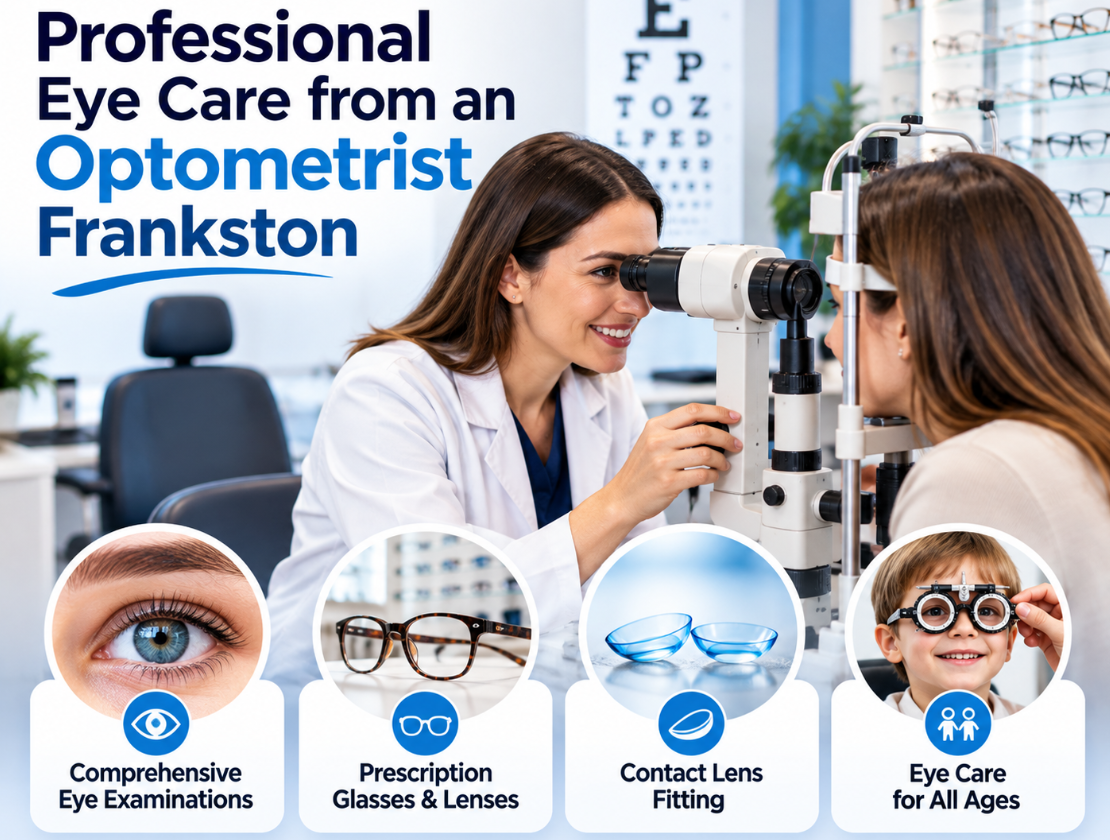
When was the last time you had an eye exam? Do you find that you are squinting at your computer screen more than usual? May you have started to see your little one sitting closer to the telly than is healthy? Many Frankston residents ask these questions, but it is easy to forget about eye care when it comes to health.
The reality is that our eyes are extremely busy daily. We’re using our vision for pretty much everything, from social media on our phones to driving down the Nepean Highway. However, many Australians only go to an optometrist when they have a clear perception of an issue. At this time, some may have reached a stage where they have gone further than they need to be.
In this guide, we’ll be looking at all the information you need to know about eye care in Frankston. You’ll learn what a thorough eye exam entails, the frequency with which it is recommended for various age groups, and the common eye conditions which local optometrists may be able to treat. Plus, we’ll share some useful tips for maintaining eye health between appointments, and discuss Medicare bulk billing options. Whether you are a parent who is worried about your child’s vision or just in the mood for a vision exam, this information will help you make decisions regarding eye health.
What Does an Optometrist in Frankston Actually Do?
Eye Tests and Vision Assessments
There are those who feel like optometrists are only there to provide glasses for people. Eye examinations performed by an eye doctor will assess how well you can see at different distances. They will test how well you can concentrate, your depth perception and how well your eyes work together.
Of course, these evaluations are made on a chart with letters. But today, there’s more to it than that: Today, your peripheral vision is tested, as is how you react to the light. It is an all-round treatment that provides full visual health information.
Detecting Eye Diseases Early
One of the most important duties of an optometrist is making an early diagnosis of eye diseases when they are not yet evident. Diseases such as glaucoma can occur without symptoms, resulting in permanent damage. The use of regular exams helps optometrists identify these problems at an early stage, when they can best be treated.
Prescription Glasses and Contact Lens Fittings
After your eye exam, your optometrist will be able to give you corrective lenses that fit your needs. This involves correct contact lens fitting, where attention is paid to accurate measurement of the surface of your eye so that the contact lenses are comfortable and provide the best correction.
What Happens During a Comprehensive Eye Exam?
Step-by-Step Breakdown of Your Appointment
It may seem a little intimidating if you haven’t visited the optometry practice in a long time. Here’s what you can expect during a typical appointment in Frankston.
First, you will talk about your medical history and any concerns you have observed. Your optometrist should be aware of any medication you are taking, as some can have an impact on your eyes. They’ll also inquire about your lifestyle, such as how much screen time you have and if you work outside.
Then follows the real test. While reading letters or numbers, you’ll be reading through different lenses. Your optometrist will shine lights in your eyes to check the inner parts. You may need to cover one eye at a time to test each eye individually.
Advanced Diagnostic Technology Used by Frankston Optometrists
Your optometrists employ remarkable equipment to take a detailed look at the eyes. Detailed images of the back of your eye (retina) are taken and used to make comparisons in the future. Optical coherence tomography (OCT) gives an image of cross sections of your retina, which can help identify conditions at the microscopic level.
These technologies can result in more precise diagnoses and improved treatment results for patients.
Common Eye Conditions Treated by Optometrists
Myopia and Hyperopia
Short-sightedness (myopia) causes distant objects to seem blurry, and long-sightedness (hyperopia) can make close objects hard to see. Both of these are readily corrected with glasses or contacts. Notably, there has been a rise in the proportion of Australian children with myopia, which may be related to increased screen time and less outdoor activity.
Astigmatism and Presbyopia
Astigmatism is when your cornea is not perfectly round, and you have blurred vision at any distance. Presbyopia, a loss of focus that occurs after the age of 40, is a condition that affects the ageing process. You may find yourself placing your phone further away to be able to read the text.
Dry Eye Syndrome
Discomfort, redness and a gritty feeling are common side effects of this condition that is becoming more prevalent. It can be caused by air conditioning, screen time and some medications. Depending on the severity, treatment can be done using eye drops or more advanced treatments.
Glaucoma, Cataracts, and Macular Degeneration
These are serious conditions that need regular check-ups and care. Glaucoma is when pressure is placed on the optic nerve, cataracts are clouding of the lens, and macular degeneration is the loss of central vision. Regular eye checks are essential in identifying these conditions early and therefore are the best way to successfully manage them.
Are Eye Tests Covered by Medicare in Australia?
Understanding Bulk Billing for Eye Exams
Excellent for residents of Frankston – eye exams by an optometrist are covered by Medicare. This allows you to get bulk-billed eye exams, so that you don’t have to break the bank to get professional eye care. Most local practices provide bulk billing, and there really are no financial constraints in obtaining an eye examination.
For adults who do not have any specific eye problems, a Medicare examination can be done every three years and is bulk-billed. If you have diabetes or have a family history of eye problems, you may have tests more often than normal.
Private Health Insurance and Optical Benefits
The exam is bulk billed, but not the glasses or contact lenses. This is where extras insurance benefits can help. Various policies provide optical coverage to help reduce the expense of eyeglasses and contact lenses.
How to Choose the Best Optometrist in Frankston
Qualifications and Experience to Look For
In Australia, everyone who practises optometry should have an optometry degree and be registered with the Optometry Board of Australia. In addition to the basic qualifications, search the website for practitioners who have experience in an area of interest to you. When it comes to kids’ eyesight, look for someone with a speciality in kids’ optometry.
What to Expect from a Quality Local Practice
A good Frankston practice will have up-to-date diagnostic equipment, a variety of eyewear available and employees who do not rush you through appointments. They should never rush you through appointments and try to force you into frames that cost too much.
Prioritising Your Eye Health in Frankston
Taking care of your eyes shouldn’t be something you keep putting off. There’s really no excuse to put off an eye exam since Medicare covers the cost for bulk-billed eye tests, and quality optometrists are within easy reach in Frankston. Periodic exams detect issues early, preserve long-term visual health and give you confidence that this is one of your most valuable senses.
If you have regular eye exams, are experiencing vision changes or are worried about a family member, it’s easy to make an appointment. Today’s technology allows for exams that are faster and more accurate than ever.
Then, when was the last time you had an eye exam? If you don’t know, then that’s probably your answer. Contact your Frankston optometrist and treat your eyes to some privacy. You will be glad that you did it.